
Josh Coffey, Communications Lead
Bremen, Germany – October 2025
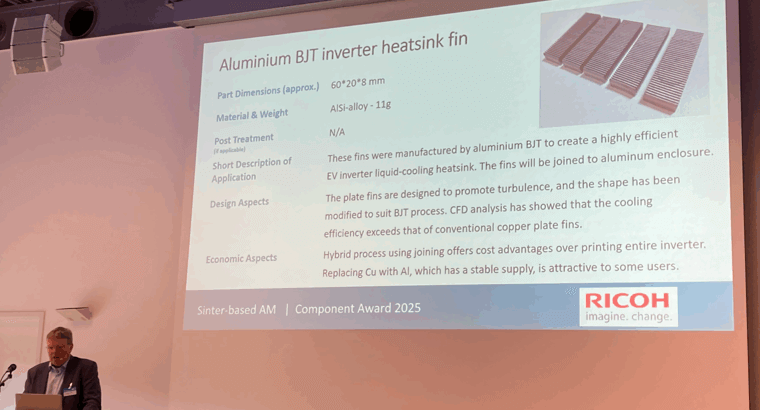
Ricoh Company, Ltd. has been awarded 1st place in the Sinter-Based Additive Manufacturing (SBAM) Component Award 2025, presented by Fraunhofer IFAM, for its innovative Aluminium Inverter Heatsink Fin produced using Ricoh’s Metal Binder Jetting (BJT) technology.
Recognition in Metal Additive Manufacturing
The award was announced on the opening day of the 2025 Sinter-Based Additive Manufacturing Workshop in Bremen, Germany — a key event bringing together leaders in sinter-based AM technologies from across the globe, including Ricoh 3D, HP and Desktop Metal.
Claus Aumund-Kopp of Fraunhofer IFAM presented the top honour to Ricoh for its outstanding contribution to advancing the use of aluminium binder jetting in high-performance, cost-effective component production.
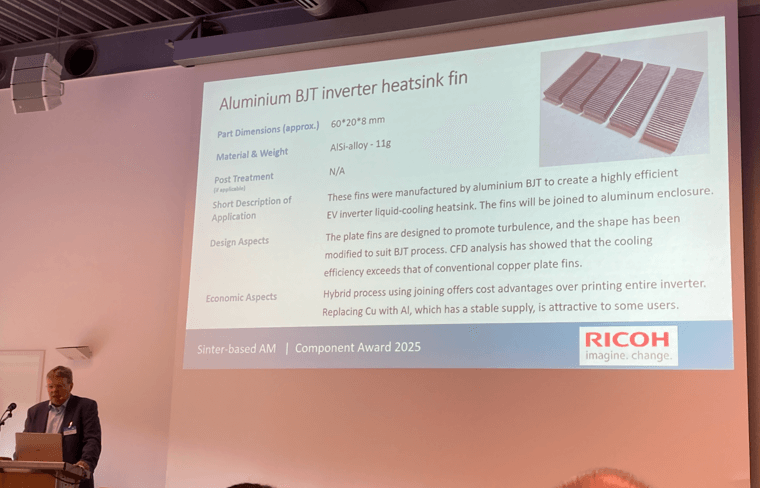
The winning component, an aluminium BJT Inverter Heatsink Fin, demonstrates Ricoh’s capability to produce lightweight, thermally efficient structures tailored for electric vehicle (EV) inverter cooling systems.
Technical Excellence and Design Innovation
The heatsink fins, approximately 60×20×8 mm in dimension and weighing 11 grams, were manufactured using Ricoh’s proprietary BJT process with AISI alloy aluminium powder. The fins were designed to enhance turbulent airflow, optimising thermal exchange and improving overall cooling efficiency.
Computational Fluid Dynamics (CFD) simulations confirmed that Ricoh’s hybrid aluminium design exceeds the cooling performance of conventional copper plate fins — all while achieving comparable production costs.
The design also incorporates a hybrid joining process that reduces the 3D-printed volume, significantly lowering material usage and manufacturing costs while ensuring robust watertightness through integration with conventionally fabricated aluminium covers.
Collaborative Development Across Continents
This achievement reflects global collaboration between Ricoh’s UK and Japan teams and a leading Japanese heatsink supplier. By working across time zones in a continuous “day-night” development cycle, Ricoh maximised efficiency and accelerated innovation from concept to prototype.
The heatsink fin was produced as a pre-production evaluation sample, with the goal of transitioning into mass production for real-world EV applications. If successful, it could mark a major step toward commercial adoption of aluminium binder jetting for functional, high-performance components.
Driving the Future of Aluminium Binder Jetting
Ricoh’s BJT technology is becoming more renowned in the metal AM space for its precision powder control, uniform density sintering, and scalability for production environments. With ongoing development in materials, process automation, and post-sintering reliability, Ricoh aims to realise full-scale aluminium BJT manufacturing that meets the demands of next-generation mobility and energy industries, and more.
Replacing copper with aluminium offers multiple benefits — reduced cost (notably at mass production scale), lighter weight, and more stable raw material supply, making it an attractive solution for large-scale production of thermal management components.
A Statement of Commitment
Insei Son, Engineer and Advisor
“We are honoured to receive this recognition from Fraunhofer IFAM,” said Ricoh 3D’s Engineer and Advisor, Insei Son, who submitted the case study entry and sample parts.
“Huge thanks to all involved in this project – from our Japanese heatsink partners, to our engineering and R&D teams, who have worked tirelessly to push the boundaries of Ricoh’s BJT technology.”
He added: “We will now continue this co-creation project with our heatsink supplier, evolving its possibilities further – demonstrating its potential for real-world production.”