

Josh Coffey, Communications Lead
Ricoh 3D x Future Engineering Developments | Pushing the Boundaries of Rotary Atomizer Design & Manufacture: A decade-long AM collaboration that continues to redefine precision, performance and agility.
An Engineer with a Vision
When Steve Rix, founder of Future Engineering Developments Ltd (FED), talks about innovation, it’s not from a theoretical standpoint — it’s lived experience.
A highly qualified, experienced and innovative electro-mechanical and electronic design engineer, Steve’s career has spanned more than three decades in product development for end users and OEMs alike.
His technical repertoire includes mathematical modelling of heating, ventilation, and air conditioning (HVAC) systems, 3D design and printing, computational fluid dynamics, and embedded micro-electronics systems — all of which underpin the engineering precision that defines FED’s products.
Beginning his career as an apprentice lift engineer, Steve quickly developed a fascination for motor control systems and variable-speed drives. That passion for motion, precision and problem-solving ultimately led him to create the first rotary atomizer capable of meeting both industrial and environmental demands.
“I’ve always loved problem-solving,” Steve recalls. “If something didn’t exist, I’d work out how to build it.”
After years spent designing and refining humidification systems and high-speed motors, Steve recognised the limitations of conventional manufacturing methods. It wasn’t until he bought a desktop 3D printer “just to experiment” that he realised the potential of additive manufacturing (AM).
“It suddenly dawned on me that I could make designs as complex as I wanted,” he says. “Additive manufacturing removed all the traditional barriers to design; I no longer had to ask, ‘how will this be made?’.” This mindset became the foundation of Future Engineering Developments Ltd, where Steve remains the sole design authority behind every atomizer the company produces.
Discovering Ricoh 3D
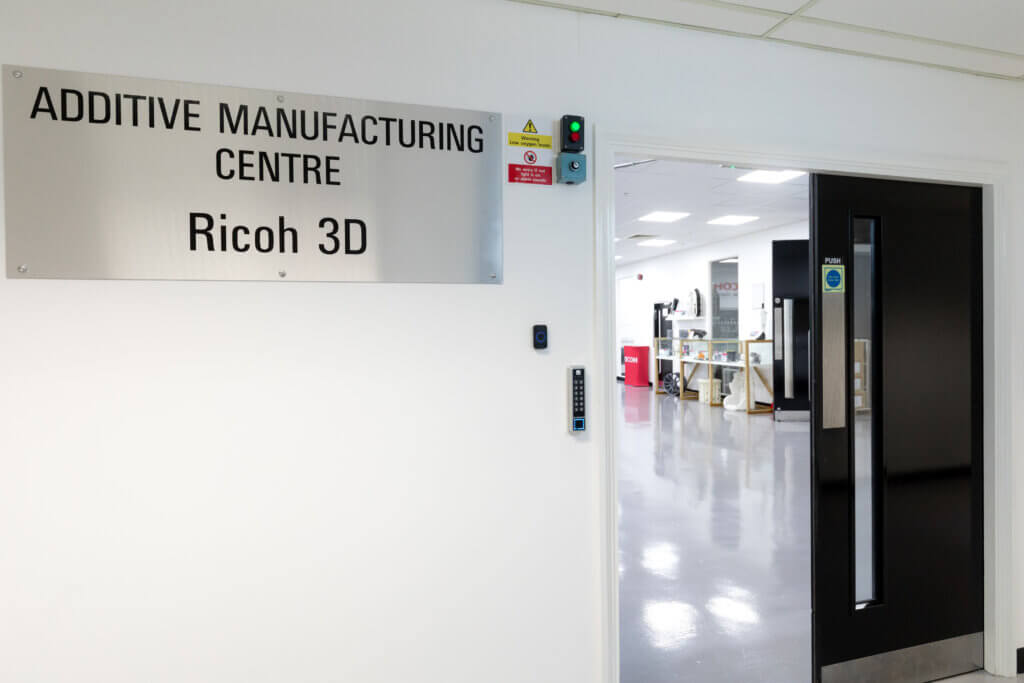
Steve first discovered Ricoh 3D online in 2015, after testing several other additive manufacturing suppliers. While early providers struggled with consistency and material quality, Ricoh’s industrial-grade precision and unique polypropylene (PP) material made an immediate impression.
“We were having problems with consistency and strength,” Steve explains.
“When we switched to Ricoh, we found the product quality to be excellent. There were pre-existing ‘teething issues’, but the team worked with me to solve them — and that collaboration made all the difference.”
Since then, FED has become one of Ricoh 3D’s longest-standing customers, growing alongside Ricoh’s own AM capability — progressing from early prototyping to fully managed serial production (3D Managed Print).
What began as a pragmatic search for manufacturing reliability evolved into a decade-long partnership built on co-creation, trust and shared technical ambition.
Rotary Atomizer: Prototype to Production
Unlike the impersonal, transactional approach of some online vendors, Ricoh 3D’s engineers worked hand-in-hand with Steve to refine build processes, validate design accuracy, and ensure repeatable performance at competitive speeds.
Together, they optimised the build ensuring each part was manufactured concentrically and with upmost precision.
“We could take a 3D-printed atomizer head straight from Ricoh, mount it on a motor, and it would run perfectly balanced — no vibration issues at all,” says Steve. “That’s testament to the accuracy of Ricoh’s manufacturing.”
The results speak for themselves. FED’s atomisezs operate at super-high speeds (12,000-24,000 RPM), some up to 60,000 RPM, yet maintain perfect stability and structural integrity.
“You’ve got a gauze that’s really very fine — about one-millimetre holes in the gauze in fact — and to do all this and get it printed accurately, so there’s no vibration when you’re spinning at over 12,000 RPM, is quite an achievement. It’s quite powerful, I think.”
This partnership has allowed FED’s rotary atomizer range — the Marvel, Mighty, Mighty SS, and Max — to evolve from early prototypes into a suite of globally deployed products.
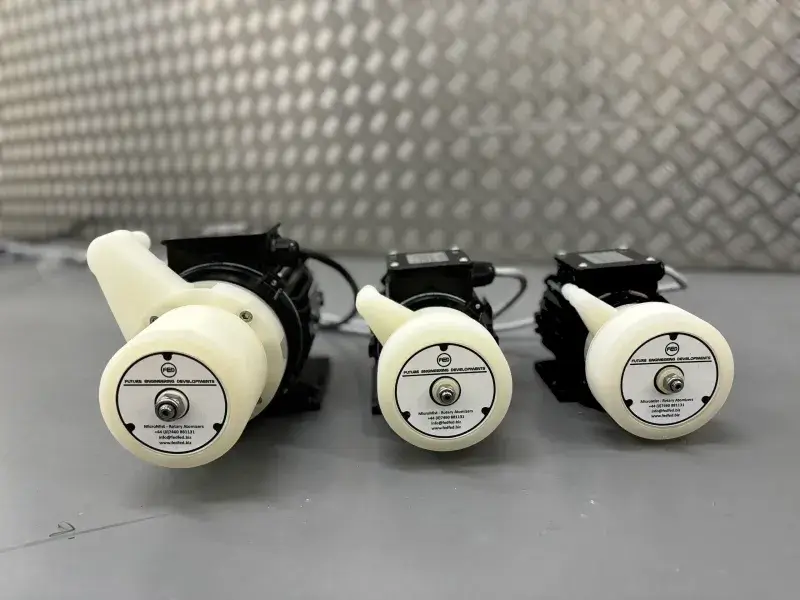
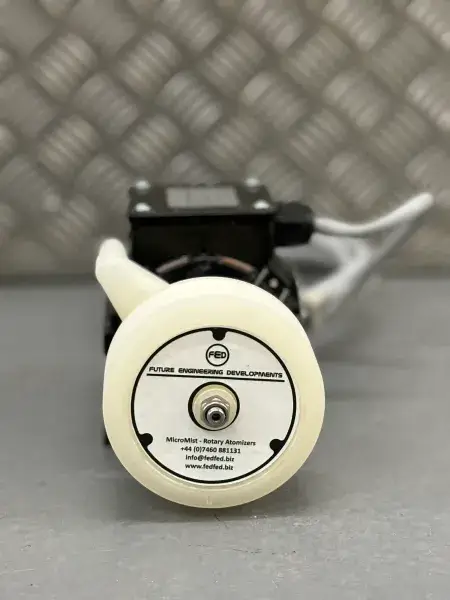
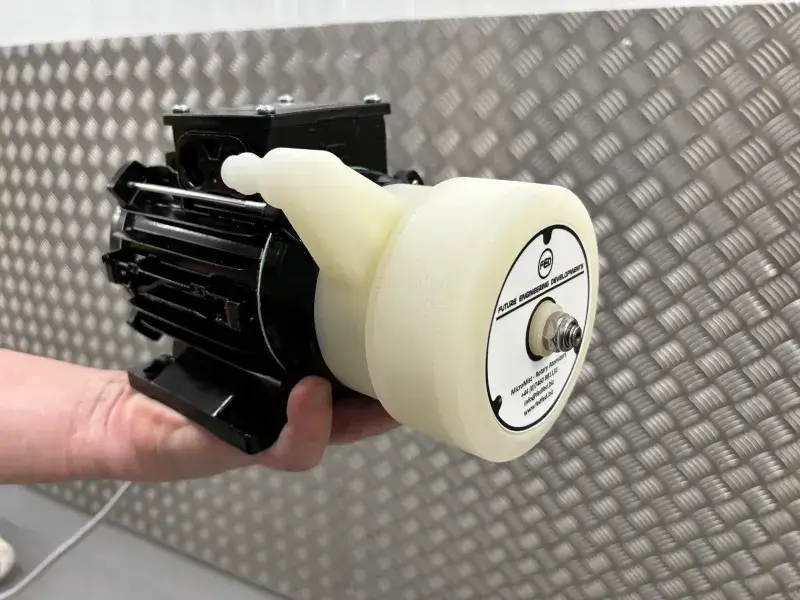
Click here to view the MicroMist™ Rotary Atomizer case study.
“Steve’s commitment to continuous development mirrors our own,” says Richard Minifie, Senior Engineer at Ricoh 3D. “We’ve grown together — experimenting, learning, and refining the process until B2B mass production became not only achievable, but efficient and repeatable.”
He added: “At Ricoh, we work in tandem with our customers to truly understand their needs and help them realise their goals.
“In this case, the end-result was a product which was and remains concentric and perfectly balanced – allowing FED to supply parts to their customers immediately, without any post-processing required.”
Material Evolution: From Nylon to Polypropylene
One of the collaboration’s pivotal milestones was the transition from Nylon 12 to Ricoh 3D’s proprietary polypropylene (PP), a shift that transformed both performance and manufacturability.
Steve recalls that the earliest atomizers were printed in nylon, but the material’s limitations soon became evident. Nylon absorbed moisture, affecting balance and longevity, and its surface energy made it prone to mineral build-up resulting in blockages during use.
“Polypropylene changed everything,” Steve says. “It’s non-stick, water-repellent and lighter — that makes it perfect for our application.”
Ricoh’s PP offered:
- Low surface energy – preventing mineral build up and blockages.
- Reduced rotating mass – improving dynamic balance and operating speed.
- Chemical resistance – vital for humidification and seawater applications.
- Water hardness tolerance – allowing atomisation of water without blockage.
- Design freedom – enabling geometries impossible in machined or moulded parts.
- Environmental sustainability – lower material use and easier post-processing.
This material innovation, combined with Steve’s iterative design approach, led to more robust, reliable atomizers and a cleaner, more sustainable production process.
Design Refinement and Sustainability
Even after nearly a decade of success, Steve continues to fine-tune his designs — focusing on incremental improvements that enhance performance while reducing environmental impact.
“The material was a big one,” he notes. “But we’ve also simplified the design slightly, which makes it easier to produce and to clean after printing. We now use less material, which is better for the environment, and yet we haven’t compromised strength.”
Steve is now on revision #6 of the large atomizer heads — a testament to his commitment to continuous improvement (Kaizen) and engineering precision. However, thanks to his groundbreaking initial design, each iteration reflects subtle, intelligent optimisation rather than wholesale redesign, demonstrating the mark of a truly mature, refined product.
Engineering for the World
Today, FED’s atomizers are exported worldwide, with installations across Europe, Asia, and Australia. They’re used in brewing and malting, aggregate handling, climate control, and dust suppression — all applications where humidity control and mist precision are mission-critical.

“We’ve had orders from all over the world,” says Steve. “Every time, we find a new use-case. Additive manufacturing allows us to tailor the product to that application — it’s incredibly versatile.”
One customer has actually developed their own industrial product range based on FED’s range of atomizers.
The collaboration with Ricoh 3D has empowered FED with an agile manufacturing model — enabling them to deliver parts quickly, adapt to new customer demands, and expand their global reach.
Steve added: “I can design something in the evening, upload it through Ricoh’s online ordering portal, and have parts in production the next day.
“And if I do require further discussions or advice on something, the team are always on hand and are very responsive.
“That level of flexibility is game-changing.”
Atomiser Benefits for Customers
FED’s rotary atomizers, deliver multiple performance and sustainability benefits for end users:
- Very uniform mist with adjustable droplet size.
- Extremely low water pressure required, reducing system energy costs.
- Tolerance to hard water and saline conditions — able to atomise seawater.
- Virtually immune to blockage, thanks to smooth internal surfaces and low surface energy of PP material.
- Low maintenance and long service life, even in harsh industrial settings.
- Highly reliable operation — minimal downtime, consistent performance.
These qualities translate into lower operational costs, fewer maintenance cycles, and improved environmental efficiency for FED’s customers.
Testimony from Ricoh 3D

Richard Minifie, Senior Engineer
“Future Engineering Developments has been with us since the early days,” says Richard Minifie, Senior Engineer at Ricoh 3D. “Steve’s journey with us mirrors our own as a business. He’s our longest-standing customer, and together we’ve seen his product evolve from a prototype into a suite of globally-used atomizers.
“It’s been a pleasure to follow Steve’s success. He’s been part of Ricoh 3D’s journey too — helping us develop as an agile business, driving new learnings, and shaping our continuous-improvement approach.
“His products are true AM innovations — leveraging the full end-to-end benefits of additive manufacturing. They’re only possible because they were designed for AM from day one. They really do tick all the fundamental boxes.”
What’s Next for Future Engineering Developments?
Looking ahead, though tight-lipped with some exciting developments in the pipeline, Steve plans to expand the rotary atomizer concept into new markets and scales, including consumer-facing products aimed at improving air quality and climate control.
“I’m really interested in sustainability and global warming,” he says. “The next step is to harness this technology at even higher volume and improve accessibility — something affordable, mass-producible, and beneficial to people’s daily lives.”
Together, FED and Ricoh 3D continue to co-create smarter, faster, more sustainable solutions, aligned with the United Nations’ Sustainable Development Goals (SDGs) and Ricoh’s wider commitment to a circular economy.
About Future Engineering Developments
Based in the UK, Future Engineering Developments Ltd (FED) specialises in the design and manufacture of rotary atomizers for dust suppression, humidification, and evaporation.
Founded and led by Steve Rix, a pioneering engineer and innovator, FED delivers high-performance, precision-engineered solutions trusted by industries worldwide.
Learn more at: https://rotary-atomizers.com/