
Josh Coffey, Communications Lead
Additive manufacturing is often seen as a breakthrough technology…
It enables design freedom, reduces weight, and opens entirely new possibilities for complex geometries. Yet many manufacturers quickly reach a frustrating reality:
“AM is excellent for prototyping, but the costs don’t add up for mass production.”
“We replaced an existing part with AM, but we aren’t seeing the expected benefits.”
These are common walls — and they highlight an important truth:
The value of AM is not unlocked through part replacement alone.
The Trap of Partial Optimisation
According to Ricoh Company Ltd’s Researcher (Advanced Technology R&D Division), Yoichi Ito: “In many factories, AM adoption still equals traditional DfAM (Design for Additive Manufacturing). Often, this means focusing on topology optimisation for weight reduction, consolidating multiple parts into a single printed build, or even simply printing an existing component in a new way.
“But Ricoh, today, challenges this approach with a critical question: ‘Is that DfAM really increasing the value of your product?’”
Simply replacing a conventionally manufactured part with an AM version — while keeping the surrounding system unchanged — can actually lead to higher cost and limited benefit.
This is what Yoichi defines as the “Trap of Partial Optimisation.” A trap that prevents AM from delivering its greatest strength:
The ability to create entirely new system architectures through design freedom.
From DfAM to RDfAM
“To escape this trap and create value at the system level, I propose a new design methodology: RDwAM (Revolutionising Design with AM)”, said Yoichi.
This is not just a technique for shaping parts differently. It is an innovation of the design process itself, combining:
- System Thinking — understanding the full surrounding module and architecture
- Design Thinking — uncovering deeper functional needs and opportunities
- Front-loaded reinvention — redesigning before drawing the first blueprint
In short: AM delivers the most value when we don’t ask “How do we print this part?”
But instead ask:
- Do we even need this component anymore?
- Can we eliminate entire subsystems?
- What would this design look like if AM were the starting point?
The Manifold: Aluminium Binder Jetting in Action
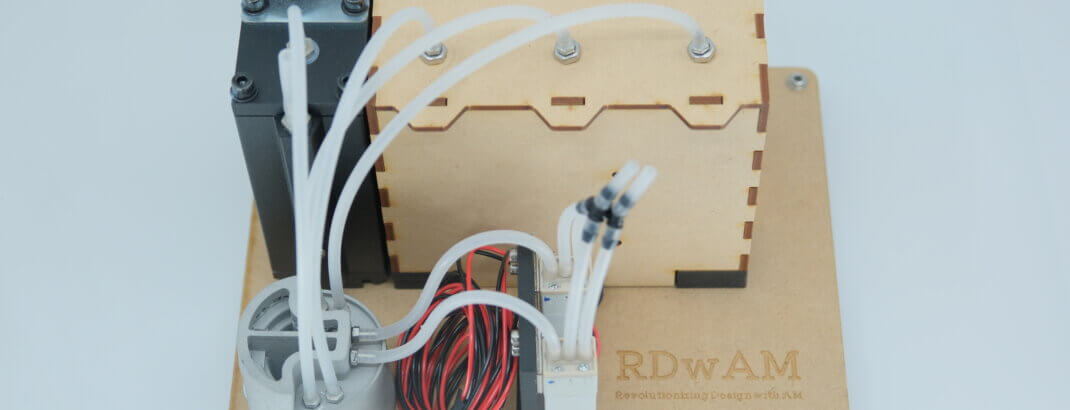
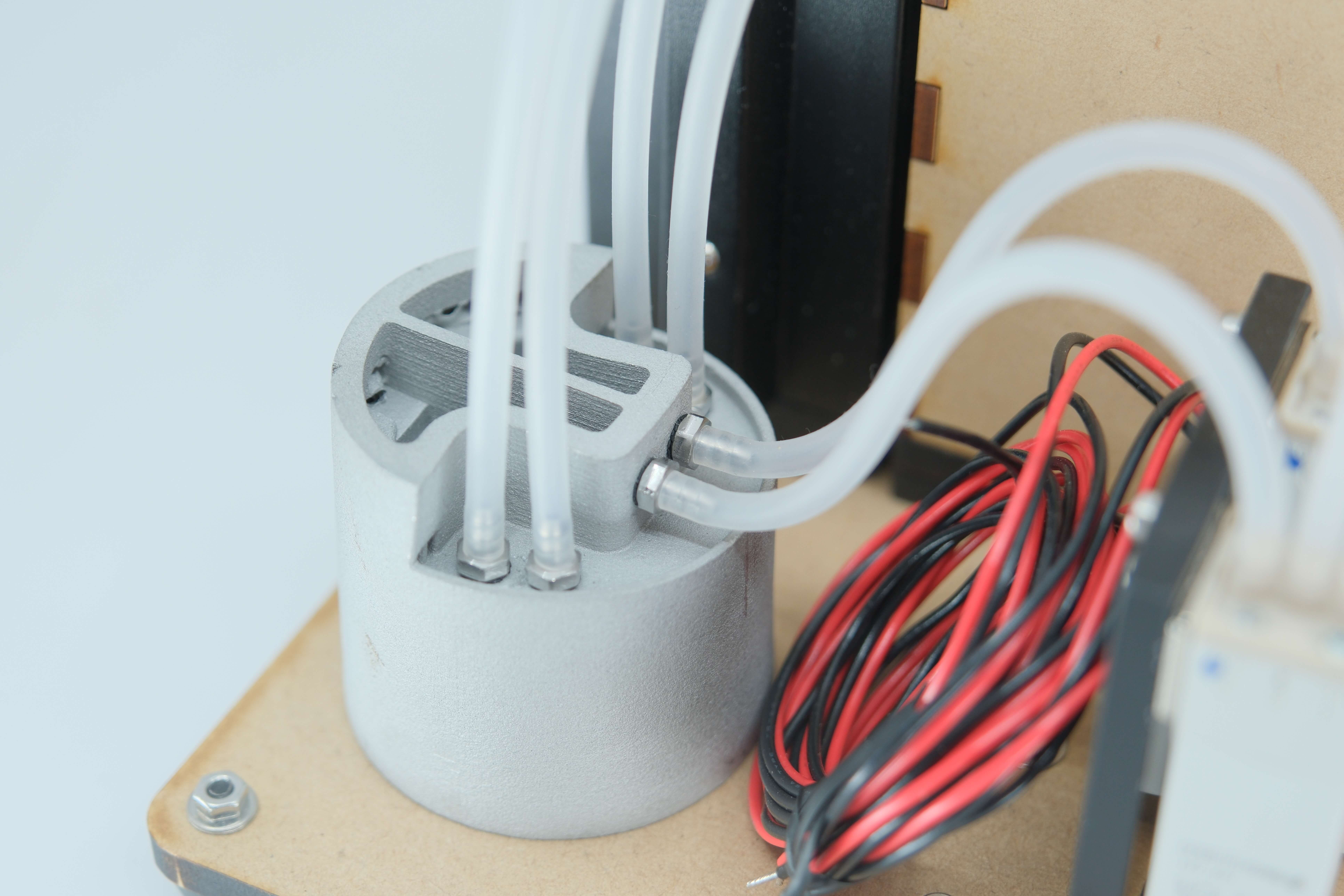
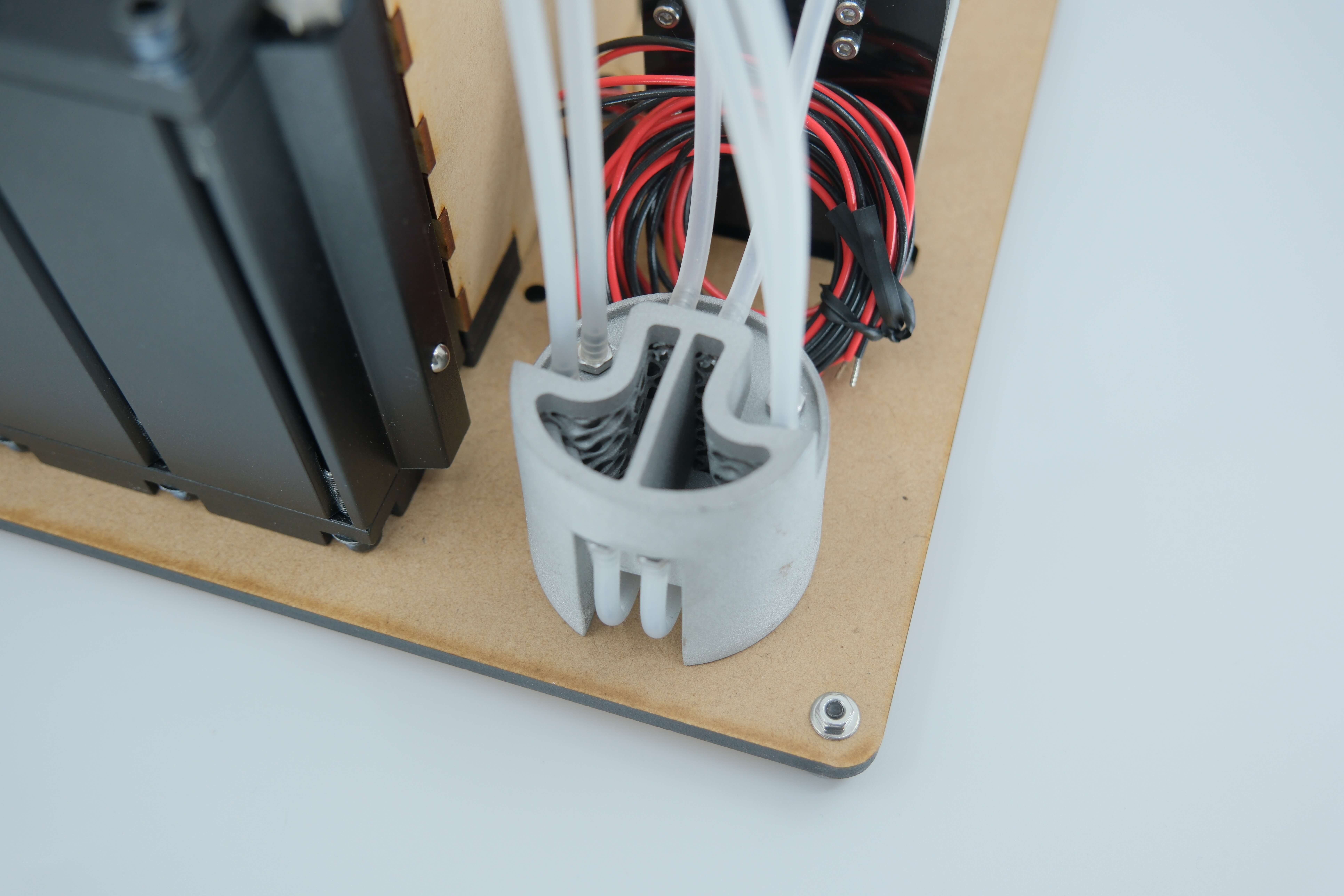
One of the strongest examples of this philosophy is Ricoh’s aluminium binder jet inkjet manifold.
This application demonstrates how additive manufacturing becomes a tool for real innovation — not simply compact design, but system-level optimisation driven by customer value.
The manifold was co-created by Ricoh Company Ltd and Ricoh Printing Solutions Europe Ltd’s (RPSE) Integrated Services business – the home of Ricoh 3D.
Together, the teams developed a module that delivers:
- Reduced size and weight
- Improved functional integration
- Optimised ink delivery performance
- Scalable potential for production applications
Fewer Valve Units, Greater Efficiency
Thanks to the manifold’s highly complex internal structure, Ricoh was able to reduce the number of valve units required within the overall module.
This results in:
- Lower mechanical complexity
- Improved performance stability
- Enhanced efficiency in ink circulation
This kind of redesign is only possible through additive-enabled system reinvention.
Advanced Internal Architecture Without Compromise
Despite downsizing, the manifold retains sophisticated fluid control architecture, including:
- Four fully segregated internal areas to prevent ink colour mixing
- A path for retaining backflowing ink
- An integrated reverse flow detector
This demonstrates how Ricoh’s binder jetting technology (BJT) enables compactness without sacrificing performance or function.
From Formnext 2024 to Continued Refinement
The manifold was first exhibited at Formnext 2024, marking a major milestone in Ricoh’s development of production-ready aluminium binder jetting applications.
Since then, it has been further refined — reinforcing Ricoh’s commitment to continuous innovation beyond prototype-level AM.
Integrated Services at RPSE
What truly differentiates this case is the model behind it. Today, Ricoh 3D offers more than additive parts…
The Integrated Services business brings together Ricoh technologies and 90 years of industrial inkjet expertise, to help customers realise new value. The result? One integrated ecosystem. This is how Ricoh helps customers break through the AM wall — and turn technology into true business value.
Co-create with Ricoh
The manifold case study is proof that additive manufacturing succeeds when it transforms the system, not just the shape.
In his own words, Yoichi commented: “RDwAM is a weapon for designers to proactively go and define the system. It is about breaking away from passive design – building exactly to specs – and using AM as a lever to transform the entire system, the supply chain, and even perhaps, the business model.”
He added: “I believe the key to crossing the ‘Valley of Death’ and turning technology into business value lies in the transformation of design, and more integrated services.”
If your organisation is ready to explore production-ready additive innovation and Integrated Services, please contact Ricoh 3D today.